Thursday, May 10, 2012

Arrival of Winter

I've been feeling silly recently for bundling up so much in the mornings and at night.  I've just been COLD!
Yesterday morning I realized that the ground was covered in frost as I waiting to give breakfast meds and felt very vindicated.  This morning was the same, so I broke out the camera.  Winter, at least in my eyes, has officially arrived.


Monday, May 7, 2012

Llama!!


We bought some puffed wheat or something (people food) and went back to make friends with the llama.


We made friends fast.


Angel's turn!


Not sure what to do?  Feed him!


Hmm, this is a cute llama...


What happens if I put the food in my mouth?


Llama kiss!!!


 Check out that post-kiss llama smile! 


I wanted a llama kiss too.


Got one!

Such a fun trip to the zoo :)

Wednesday, May 2, 2012

Oruro to Cure my Cabin Fever

I woke up last Thursday and nearly all I could think was, "I hate this place.  This whole stupid country.  I'm done.  I want to leave now."

Nothing had happened, not even to my hormones.  I just woke up that way.

I knew something in me was just snapping.  Honestly, I love that I now live in Bolivia with these precious boys and I live with them.  God has truly blessed me by placing me as a constant in their daily lives.  I DON'T WANT TO BE ANYWHERE ELSE.

Even when I met Angel for lunch, after receiving his enthusiastic greeting, I mumbled, "I hate your country today."  He tried to ask (more than once) what had happened, but I shrugged him off because I didn't really know what was going on.

Later in the afternoon we were talking on the phone about our upcoming Worker's Day plans.  I had chosen a while ago that we would spend the day at a nearby park with a beautiful waterfall.  I love the times that we have been able to spend in parks because not only are they beautiful but I am outdoors and need the relaxation time.  But the thought of just sitting in a park for an entire day had me sure that I would go crazy.  So I asked, "Are you sure you want to go to that park?  Or would you prefer to do something more active?"  I had no ideas as to what that "active" thing would be...

And Angel answered with the magic words.

"Actually, I was thinking we could travel..."

Days later he was still laughing about how I gushed, "oh yes please!"  You see, I have gone from traveling internationally every couple of months and domestically on top of that along with not having lived in the same spot for a full year since I moved out of my parents' house 10 years ago...to living in the same room for nearly 2 years, which is in the building where I work, and only having left to visit somewhere else ONCE.  I don't even leave the BLC on a lot of days.  NEARLY TWO YEARS!!!

I had cabin fever and didn't even realize it.

In Angel's words, "Oruro is the closest far away place" so that is where we headed Monday afternoon.


My faithful driver for the long trip.


I still love mountains.
And all the random llama herds we passed along the way.


Cochabamba just doesn't have sunsets.  Just as we were arriving in Oruro, God gifted me this.


Breakfast just off the main plaza with a workers protest and march going on outside.


Yes, the name of the restaurant is "El Negrito"


Statue of miners outside of a church built over the entrance of a mine.  Oruro was initially founded as a silver mining town, and then a tin mining town, but both sources are now exhausted.


Stairway beside the church to platforms with great views of the city and a giant slide to come down.  Yes, we came down the slide.  Fast and bum bruising!


One of several disturbing paintings inside the church.  Since miners have to go down into the earth, their patron saint so to speak are demons.  I don't know how that works.  Oruro has the largest Carnaval celebration in Bolivia and it is best known for its "Diablada" or dance to the devil.  Another creepy painting in the church showed the Diablada dancers just under Mary, next to the Pope, and above all the normal people.


Us and Oruro!
I'm really glad at this point that the meds for altitude sickness that Angel so kindly went out and found in the middle of the night in the freezing cold were working.


Angel and the pigeons in the central plaza after the protest.


We stumbled upon the train station while looking for the zoo.  Because of all the old mines, it supposedly has a really amazing train system.  Some day when I make it to the salt flats, I will get there by train from Oruro.


We found the zoo and the first stop was Gonzalo the condor (Bolivia's national symbol).  I was not expecting that other condor in the background to fly up right beside!


It's a blurry photo, but hopefully you can see the lack of fencing.  That llama is on the loose!  Our close encounter with the loose llama will be my next blog...


Another llama, this time behind a fence.  There were actually 3-4 llama related animals, but I can't tell them apart, so I'm going to stick with calling them all llamas.


Another wild species loose within the zoo.


This is another llama-thing.  I wish I knew the difference...one llama thing was loose, other llama things were behind a fence that we could (and did) reach over to pet the guy, and this fella was behind a fence and a moat.  I guess those big eyes must be deceptive.


After a yummy lunch of lamb, which is the typical plate in Oruro, we were headed back home to Cochabamba again.  The scenery was still amazing to me, like these networks of handmade rock walls.


There were TONS of dogs all along the way just sitting on the side of the road in the middle of nowhere looking like they were waiting for something.  And according to Angel that is exactly what they are doing.  At the toll booths the little old ladies sell giant packs of bread...and lots of people buy these to throw out their windows to the dogs.  They just have to sit and wait for the right car to go by!


We stopped and tried to enjoy the view on the way home, but it was frigid!  We only lasted long enough to take a photo or two.

Wednesday, April 25, 2012

Yapa

In Bolivian, when you buy something from a vendor, they usually give you a little something extra at the end which they call "yapa."  For example, you buy 25 mandarin oranges for 10 bolivianos (about $1.50) and after they bag it all up for you and you pay them, they throw in an extra orange for your yapa.  Or if you buy a ridiculous amount of sugar and pasta from the same lady, she might give you a small bag of salt for your yapa.  Or if you go to a little stand where they make fruit juice sometimes when you give your glass back they put just a little more in it.  It isn't required, but it is nice.

Over the weekend I went to the market and into the meat section to buy some chicken liver for Chief (my doggy).  I paid for my kilo of liver and the lady bagged it up...then paused and sliced a bit of nearby chicken off and slipped it into the bag with a smile saying "your yapa."  It sat in the fridge for a couple of days while Chief finished his other food, but I was curious what exactly I had been given when it was time to open the new bag.  And inside I found this...


A lovely little chicken head.  Awesome.

Tuesday, April 24, 2012

Little Accident

The road in front of the BLC got really washed out during rainy season and was pretty difficult to get around, so we were initially really glad to see the big truck bringing in loads of dirt and rock to fix it.  Until...


That electric pole should NOT be at that angle.  Big truck took it out.  There is a hint of smoke in the bottom left corner of the photo because the broken lines were on fire in the trees.  Exciting for sure.

After the gringos persuaded the Bolivians it was not a good idea to have the kids help throw a rope over the line and pull it down, we ran out to buy candles for the evening.  It would be nearly 3 hours before the electric company would even show up.  Just before midnight, the lights came back on.


Now we have a nice new concrete pole.

And our road is better.

I guess it was all worth one candle light dinner!


Monday, April 16, 2012

Blockades (Part 2- How they affect the BLC)


The BLC has daytime staff and nighttime staff.  Unfortunately all of our daytime staff comes from the city of Cochabamba and if the road is blocked, they can’t make it out to the BLC.  Meaning no daytime staff.  And if they can’t make it through, most of the teachers from the local schools won’t make it through either.  Meaning no school that day.  Meaning all of our boys are stuck at home with no supervisors.  This is bad.

Thank God there are now a couple of us that live on the BLC property and are here blockade or no.  We put on our battle gear and desperately try to come up with structure for the restless mob of children while simultaneously praying that the blockade is resolved by the end of the day and doesn’t stretch on for two weeks as is sometimes the case.  We send the bravest out in search of food and cooking fuel to stock the BLC just in case it does last a long time.

And then we…

Watch movies

Play foosball

Huddle around any available cell phone to play its free game

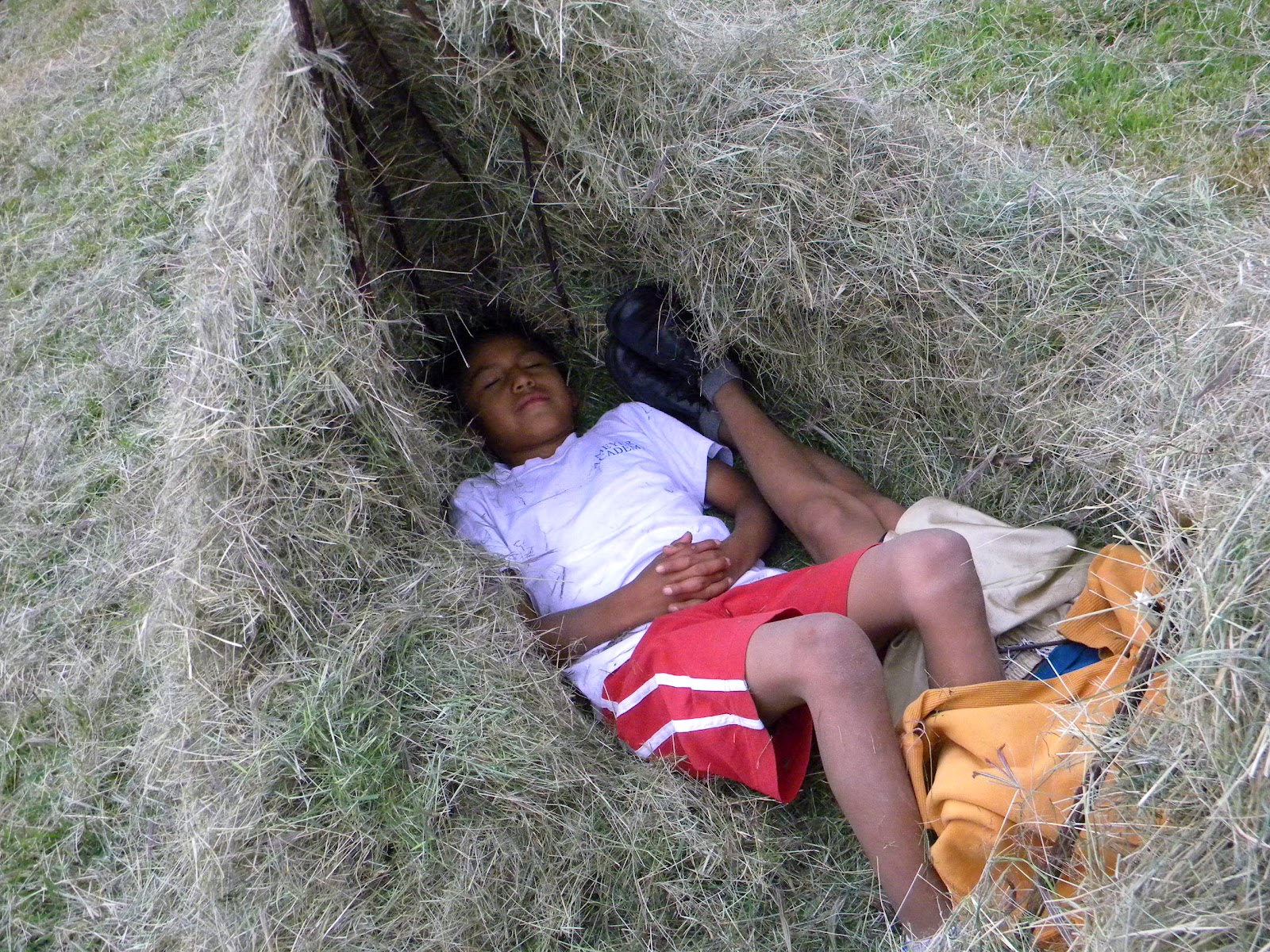
Pull the carpet out of the truck and the cushions off the sofa to lay around in the grass

Play marbles

Make forts out of the grass clippings and stage a war...something very similar to Braveheart happened, including the yelling and final charge, except that they made it China vs USA!!

Add tee-pees to the mix

Invite a friend for a nap in your now even cooler grass fort

Get tired of smelling your friend's feet and build a double-wide fort

Go fishing for puppies...there is a bone tied to the end of that string on a stick!


In early March we actually had 8 blockades in a period of 7 days.  Craziness.  One of the blockades involved a city-wide walkout of all doctors to protest the government forcing them to change to an 8 hour work day instead of their 6 hour work day with no change in pay.  If you suddenly had to work 2 hours extra EVERY DAY with NO pay increase, you'd probably walk out too.  Unfortunately this happened the day that one of my family visit boys broke his collar bone and needed emergency surgery.  Thank God He has given me some wonderful contacts and some doctor and nurse friends came running to treat him.  My boy is recovering with no problems.

Monday, March 19, 2012

Blockades (Part 1-What are they and Why do we do it)


If you’ve been my friend on facebook more than a couple of days, you’ve probably seen me mention blockades pretty frequently.  They are so different than anything you would find in the States, and are now such a big part of my life, that I figure it is time to explain.

Blockades are set up by the people, not government or police.  Sometimes the government officials of small villages will recommend them or come out in favor of them, but blockading is a constitutional right of the people.  Occasionally the police will break up a blockade set by only a few people, but most of the time they are just around to help turn traffic away…or aren’t around at all.

 
Blockades completely block traffic.  In the States, if you wanted to drive from one city to another, there are approximately a thousand different routes that you can take.  Not true in Bolivia.  There is one way.  That is all.  So blocking a road means that not a single solitary vehicle can get from city A to city B.  We are absolutely trapped where we are.  If it is a small blockade, you can take public transportation up to the blockade, walk through the area that they are blocking (a couple of kilometers), and take a different form of public transportation on the other side.  Once a blockade opens up, you still don’t want to go out too soon, because all the big trucks that bring food and items from state to state have had no option other than to park on the side of the road and wait for it to open again.  The traffic jam is horrendous!

Blockades are generally peaceful.  Rocks, piles of dirt, old tires, and/or tree limbs prevent cars from getting down the road, and then there are just the people insisting that others go no farther and occasionally holding banners (these help me as I have no idea why they blockade if there are no banners present).

Occasionally blockades do become violent.  Tires of vehicles trying to pass are slashed.  Rocks are thrown to break the windows of vehicles trying to pass.  Rocks are thrown at people on the other side of the issue.  Fist fights break out.  Just last week in the blockade, rock throwing sent 20-25 people to the hospital with injuries.


Blockades are an attempt to get the attention of the government.  It isn’t like the USA in that we have representatives who discuss possible changes in laws that we can call or write or email and communicate the direction we wish them to take on our behalf.  Here, you just walk through the plaza like any other day to catch your bus and come across some guy selling little booklets about the new law that recently passed raising your taxes, or cutting your benefits, or requiring you to work longer, or taking away school breakfasts.  By the time you hear about it, it is already a law.  So we take to the streets in protest, because it isn’t a law that the people wanted, until the government hears us and revokes the law or adds to it to fix it according to the will of the people.  Bolivian government isn’t here to serve the people.  Bolivians are constantly fighting against their government at every turn.

Sometimes people are forced to blockade.  For example, tomorrow a local school wants to blockade, because two months into the school year they are still not receiving the school breakfasts that the government is supposed to provide.  So all students and parents are required to be present to make the blockade or they will be fined 100bs (which is a LOT for a Bolivian).